Dishes and Dimes - A Close Look at Assists

by Aqeel Phillips

With the introduction of the new SportVu advanced statistics that the NBA has officially introduced at the beginning of November, I’ve been most intrigued by the new passing statistics now at the disposal of the fans. It’s been well known around stat-heads for a while that Assists are a flawed metric for measuring a player’s contribution to their team. They simply serve as a tally with no weight to them, a cross court pass to an open player in the corner yields the same number of Assists as a pass inside to a big man who does most of the heavy lifting by skillfully posting up. Though some public websites track the number of assists that lead to three-pointers as opposed to deuces, there is still no stat that accounts for passes that lead to free throws, and passers are robbed of rightful assists that they should receive when a play ends in a shooting foul. SportVu will be tracking these statistics, but I’m too impatient to wait for the season to progress and the sample size of SportVu to increase sufficiently, so I set out enumerate the contributions of passers from last year’s NBA season.

The Three-Pointers: Creating Valuable Shots

Let’s start by reminding ourselves of the Assist leaders from last year:
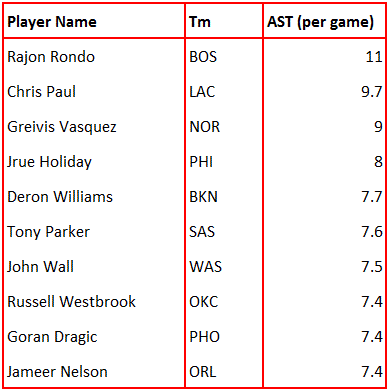
Assists

As stated previously, these assists merely serve as a tally of passes a player completed that led to field goals. We can gain a better picture of each passer’s contributions by taking a peek at a lesser-known statistic called Weighted Assists (shorthand AST+, courtesy of Hoop Data), which weights three-pointers as 1.5 as valuable as regular field goals. From AST+, we can easily calculate the amount of points from field goals that a player produced per game, by multiplying their AST+ value by two.
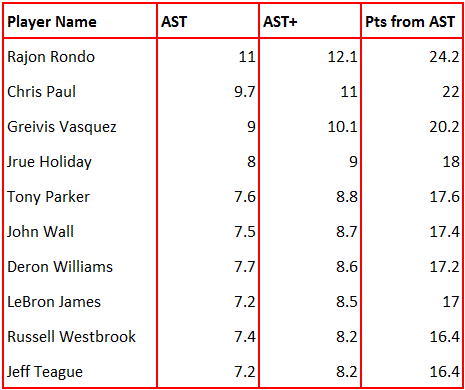
Table2

Continue reading “Dishes and Dimes - A Close Look at Assists”

Using SportVU to find the most overrated defenders in the NBA

dj block

By: Patrick Harrel

In the quest for advanced statistics capable of accurately quantifying defense, NBA analysts have always faced an uphill battle. Unlike offense, which had easily quantifiable measures of success, readily available statistics came nowhere close to establishing how effective a defensive player was on the floor. If a player blocked a lot of shots, he was often lauded as a tremendous defender, but what if those blocks came at the cost of missed rotations and wide open layups on failed attempts? Until very recently, we couldn’t dream of answering a question like that comprehensively.

When the NBA announced this year that they would be making the SportVU data available to the public for the 2013-14 season, the news was met with raucous applause from all circles involved with basketball. Writers loved it, fans loved it, and statisticians, who had always only been able to make educated guesses about certain factors, adored it. At Princeton Sports Analytics, we are going to make the data more accessible to you in a bi-weekly column, with each entry dedicated to a specific aspect of what is going on in the NBA.

If you are unfamiliar with SportVU, it is a system that is now installed in all 29 NBA arenas that tracks the movement of all 10 players on the court, the 3 referees, and the ball, and automatically generates an incredible amount of data about the various outcomes on the floor. It tracks average speed of every player, how many touches any given player gets per game, and much more.

Today, we’re going to discuss the ability to better quantify defense. Specifically, we will look at who have been some of the surprisingly poor interior defensive players this season. SportVU measures how well players defend inside by charting every shot attempt that an offensive player takes when a defender is both within five feet of the basket and within five feet of the offensive player. It then measures what percentage of shots the defensive player allows to be made under these conditions.

Continue reading “Using SportVU to find the most overrated defenders in the NBA”

Past Achilles injuries show that Kobe Bryant’s #NBArank is more than generous

By: Patrick Harrel

Kobe Bryant recently changed his twitter avatar to a simple image of the numbers “1225,” an obvious nod to ESPN’s respective predictions for the Lakers performance in the West and Kobe’s performance this season in comparison to his NBA counterparts. He, along with Laker Nation, was appalled to see both ranked so poorly. The NBA Rank methodology may be a bit primitive, with each voter voting on a 1-10 integer scale to rate all the NBA players on the list, but the ranking nonetheless reflects a reality that Kobe is likely to regress after rupturing his Achilles tendon.

But how much will he regress? Dr. Douglas Cerynik and Dr. Nirav H. Amin of Drexel University did some research into Achilles ruptures in their paper Performance Outcomes After Repair of Complete Achilles Tendon Ruptures in National Basketball Association Players, and shed some light as to just how difficult it is to come back from an Achilles tear. Of the 18 players they looked at, 7 were never able to return to NBA action, 3 returned for just one season, and the remaining 8 would go on to play 2 or more seasons.

And of those players that did return, their performance suffered drastically, especially in their first season back. In their study of the 11 players that returned to the NBA, the players PER (player efficiency rating), decreased by an average of 4.57 points. In the second, it decreased by 4.38 points. Even after controlling for age and other confounding variables, both figures were statistically significant, the first with a p-value of .038 and the second with a p-value of .081.

If you are unfamiliar with PER, it is an attempt at an all-encompassing rating system that sets the league average at 15. An All-Star typically has a PER in the range of 21 or above, and an MVP will be in the 27-30 range. Last year, Kobe had a PER of 23.10. If his PER fell by the mean decrease seen in the study of 4.57 in 2013-14, it would be 18.53, or .07 points worse than Samuel Dalembert’s PER last year. When Kobe is compared to the mediocre center the Mavericks just signed as a stopgap to please the fan base in Dallas, he suddenly doesn’t seem so intimidating.

Continue reading “Past Achilles injuries show that Kobe Bryant’s #NBArank is more than generous”

Regarding Rebounds

By Avi Cohen All basic sports statistics need to be simple enough for the regular sports fan to comprehend quite readily, allowing them to understand the basics of how a player or team performed without actually watching the game. As a result of this simplicity, most are pretty flawed in some way or another when taken out of context. For instance, a typical stat line … Continue reading Regarding Rebounds

Let the NBA Back in Seattle, But Not Who You Think

The case for the Clippers to leave Los Angeles for Seattle by Dylan Ackerman In the last couple of weeks, like many Americans, I find myself intrigued with happenings in the NBA. Unlike most people following basketball, however, my interested has nothing to do with anything happening on the court. I am not completely sure how – perhaps my love of Starbucks, perhaps my desire … Continue reading Let the NBA Back in Seattle, But Not Who You Think

Why You Won’t Win Your March Madness Pool (Part 3)

By Max Kaplan This is part 3 of my March Madness bracket series. In part 1, I showed that Florida was the best team to pick to win it all. In part 2, I explained how to choose the rest of your Final Four depending on your pool size and skill. First, I’d just like to express my frustration at a fellow Princeton publication: The … Continue reading Why You Won’t Win Your March Madness Pool (Part 3)

Why You Won’t Win Your March Madness Pool (Part 2)

By Max Kaplan In part one, I showed that Florida, a 3 seed, was the best pick for your bracket even though they are not the best team in the tournament. The next step is to choose your other Final Four teams. Before moving on to the rest of the bracket, I added a few bullet points to the bottom of the previous post to … Continue reading Why You Won’t Win Your March Madness Pool (Part 2)